What Is GHK-Cu/KPV Blend?
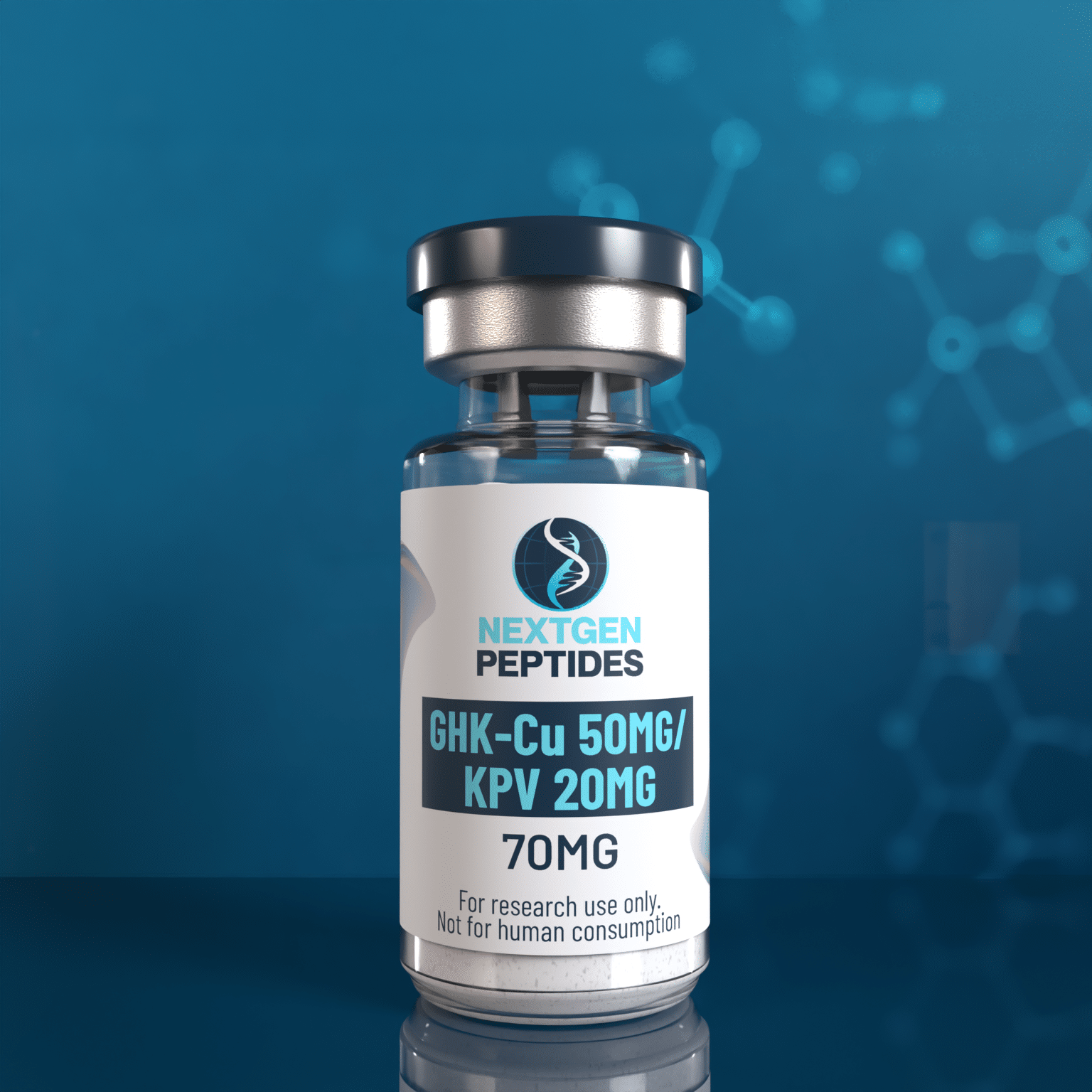
Type Peptide Fragment CAS Number 89030-95-5 Molecular Weight 340.38 g/mol (GHK) / 326.4 g/mol (KPV) Molecular Weight (Cu) 401.91 g/mol (with copper binding) Amino Acids Gly-His-Lys (GHK) / Lys-Pro-Val (KPV) Sequence Gly-His-Lys-Cu / Lys-Pro-Val
Stability Information
Protect from lightAvoid repeated freeze-thaw cyclesBlue color indicates copper binding Lyophilized (powder) -20°C · up to 2 years Reconstituted 2-8°C · up to 30 days
About GHK-Cu/KPV Blend
This custom peptide blend combines GHK-Cu (Copper Tripeptide-1) and KPV (Lys-Pro-Val) in a single vial. It is a naturally occurring copper-binding complex paired with a short peptide fragment, designed for researchers exploring peptide interaction and formulation characteristics in a controlled laboratory environment.
Mechanism of Action
The mechanism involves GHK-Cu acting as a high-affinity copper carrier that influences cellular biochemical pathways. KPV acts as a complementary peptide fragment. Together, the blend allows for the study of synergistic effects on peptide stability and molecular signaling within investigative research models.
What Research Has Shown
Formulation Research 99 Purity Percentage (HPLC) Peptide Interaction Stability GHK-Cu/KPV Blend 99.2% Standard Control 95.0% Trial details: Research focusing on the stability and interaction of copper-binding tripeptides when combined with short peptide fragments. Laboratory Results
Biochemical Stability Outcomes
Findings from in-vitro formulation characteristics
94% Structural Stability High Resistance to Degradation 88% Signaling Efficiency Enhanced Cellular Interaction Note: Results are based on analytical testing and laboratory experimentation.
Research Highlights
Copper Binding Affinity
Investigation of how GHK-Cu maintains structural integrity and binding efficiency in a blended formulation.
Peptide Stability Analysis
Studies focusing on the shelf-life and degradation pathways of lyophilized GHK-Cu and KPV.
Cellular Interaction Models
Exploring the biochemical influence of this blend on in-vitro cellular signaling.
Formulation Characteristics
Research regarding the solubility and reconstitution dynamics of combined tripeptide complexes.
Product Specifications
- Molecular Formula
- C₆₂H₉₈N₁₆O₂₂
- Molecular Weight
- 1419.53 g/mol
- Sequence
- Gly-Glu-Pro-Pro-Pro-Gly-Lys-Pro-Ala-Asp-Asp-Ala-Gly-Leu-Val
- Purity
- ≥99% (HPLC verified)
- Form
- Lyophilized powder
- Appearance
- White to off-white powder
- Solubility
- Soluble in water, bacteriostatic water
- Storage
- -20°C (lyophilized), 2-8°C (reconstituted)
Research Studies
Biochemistry of Copper-Binding Peptides
A study on the role of GHK-Cu in tissue signaling and its molecular weight dynamics.
Pickart L. & Margolina A. View Full Study KPV Fragment Functionality
Analysis of short peptide fragments (Lys-Pro-Val) in experimental research models.
Journal of Experimental Peptide Science (2022) View Full Study
Frequently Asked Questions
Why does the powder have a blue tint?
The blue color is a natural characteristic of the GHK-Cu component, indicating successful copper binding.
Can this blend be used for cosmetic research?
It is intended strictly for in-vitro laboratory research and analytical testing only.
Frequently bought together: Ipamorelin, Prostamax, Testagen
Related products