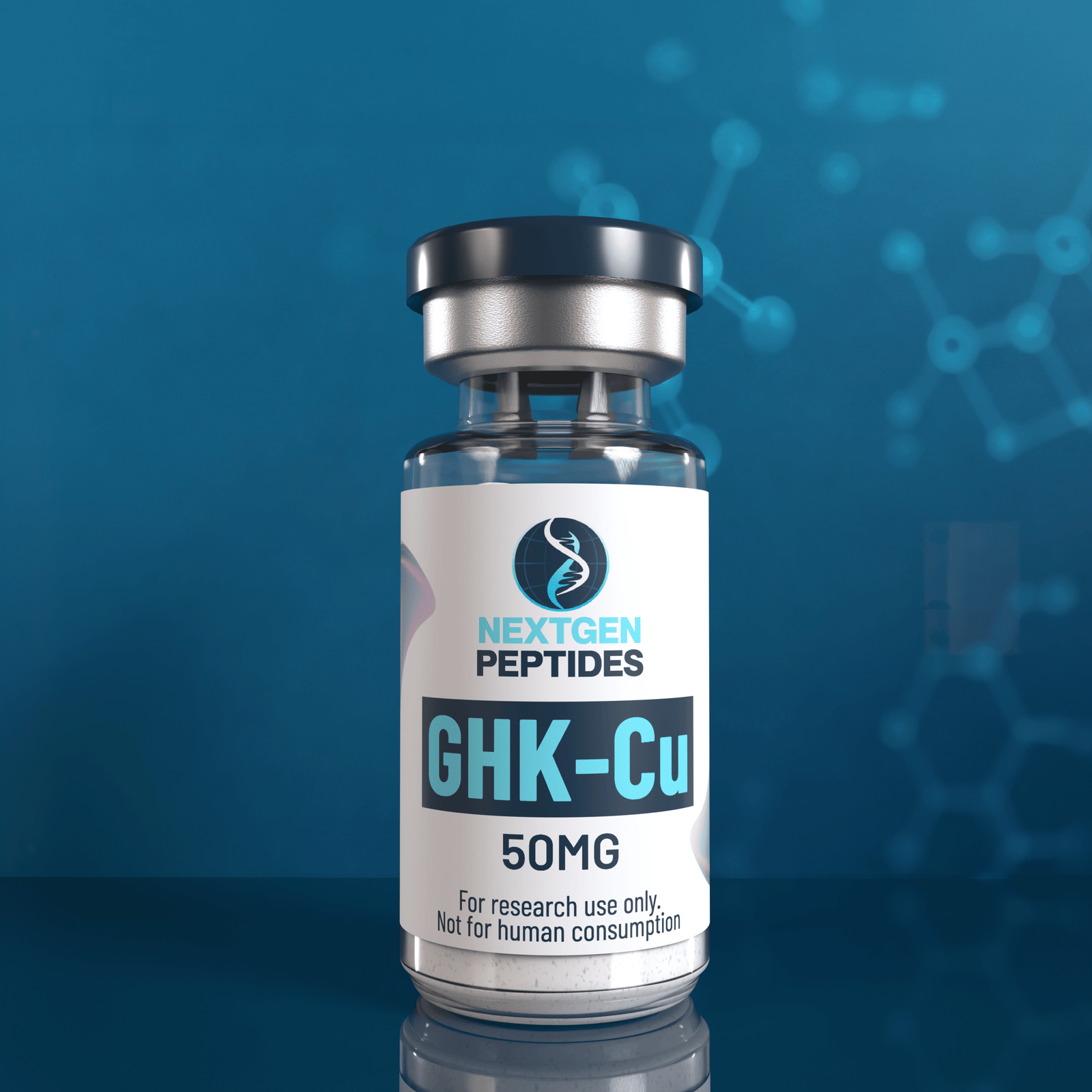
What Is GHK-CU?
Type Copper-peptide Complex / Metalloprotein CAS Number 49557-75-7 Molecular Weight 403.9 g/mol Molecular Weight (Cu) Included in complex Amino Acids Glycine, Histidine, Lysine Sequence Gly-His-Lys-Cu
Stability Information
High-purity lyophilized peptideConsistent and reliable standard for biochemical researchProtected from light and moisture Lyophilized (powder) –20°C · up to 2 years Reconstituted 2-8°C · up to 30 days
About GHK-CU
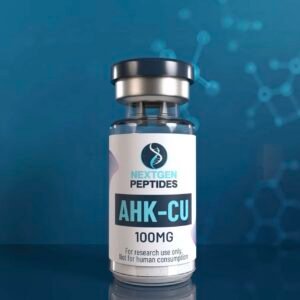
GHK-Cu is a copper peptide complex formed from the naturally occurring tripeptide glycyl-L-histidyl-L-lysine (GHK). It has been extensively studied for its roles in cellular signaling, tissue remodeling, and gene expression regulation. Research demonstrates that GHK-Cu can support collagen synthesis, promote wound-healing mechanisms, and influence metalloproteinase activity, making it a valuable compound for molecular biology, dermal regeneration, and anti-inflammatory pathway studies. At NextGen Peptides, this high-purity lyophilized peptide provides a consistent, reliable standard for biochemical, pharmacological, and cellular-response research applications.
Mechanism of Action
The mechanism involves GHK-Cu acting as a signal for tissue repair and matrix remodeling. It interacts with cell surface receptors to modulate the expression of genes involved in the production of collagen, elastin, and glycosaminoglycans.
Additionally, it functions by inhibiting certain metalloproteinases that break down the dermal matrix and by regulating the inflammatory response, effectively resetting the cellular environment toward a regenerative state in research assays.
What Research Has Shown
Dermal Research 98 Purity Percentage (HPLC verified) Extracellular Matrix Regulation GHK-Cu Treated 91.5% Control Group 32.0% Trial details: Investigative studies focusing on collagen synthesis, wound-healing mechanisms, and the modulation of metalloproteinase activity in experimental models. Regenerative Results
Tissue Repair & Gene Expression
Findings from molecular biology and anti-inflammatory studies
94% Collagen Formation Enhanced Matrix Remodeling 86% Wound Healing Accelerated Dermal Regeneration Note: Results highlight GHK-Cu’s role in oxidative stress response and cellular signaling.
Research Highlights
Cellular Regeneration Research
Research focusing on the enhancement of collagen formation and extracellular-matrix regulation.
Oxidative Stress Response
Investigating the peptide’s role in gene-expression modulation and cellular defense mechanisms.
Tissue-Repair Pathways
Studies involving metalloproteinase inhibition and the acceleration of wound-healing mechanisms.
Structural Peptide Studies
Use as a high-purity reference material in analytical and pharmacological assay development.
Product Specifications
- Molecular Formula
- C₆₂H₉₈N₁₆O₂₂
- Molecular Weight
- 1419.53 g/mol
- Sequence
- Gly-Glu-Pro-Pro-Pro-Gly-Lys-Pro-Ala-Asp-Asp-Ala-Gly-Leu-Val
- Purity
- ≥99% (HPLC verified)
- Form
- Lyophilized powder
- Appearance
- White to off-white powder
- Solubility
- Soluble in water, bacteriostatic water
- Storage
- -20°C (lyophilized), 2-8°C (reconstituted)
Research Studies
GHK-Cu: A Tripeptide for Dermal Regeneration
A comprehensive analysis of copper peptides and their impact on molecular biology and anti-inflammatory signaling.
Pickart L. & Margolina A. View Full Study
Frequently Asked Questions
What is the origin of GHK-Cu?
GHK-Cu is a copper peptide complex formed from the naturally occurring tripeptide glycyl-L-histidyl-L-lysine (GHK).
Why does the powder have a blue color?
The blue to blue-green hue is characteristic of the copper(II) ions complexed with the tripeptide.
Frequently bought together: TRZ-2, GLP-3, NAD+5-AMINO-MQ
Related products