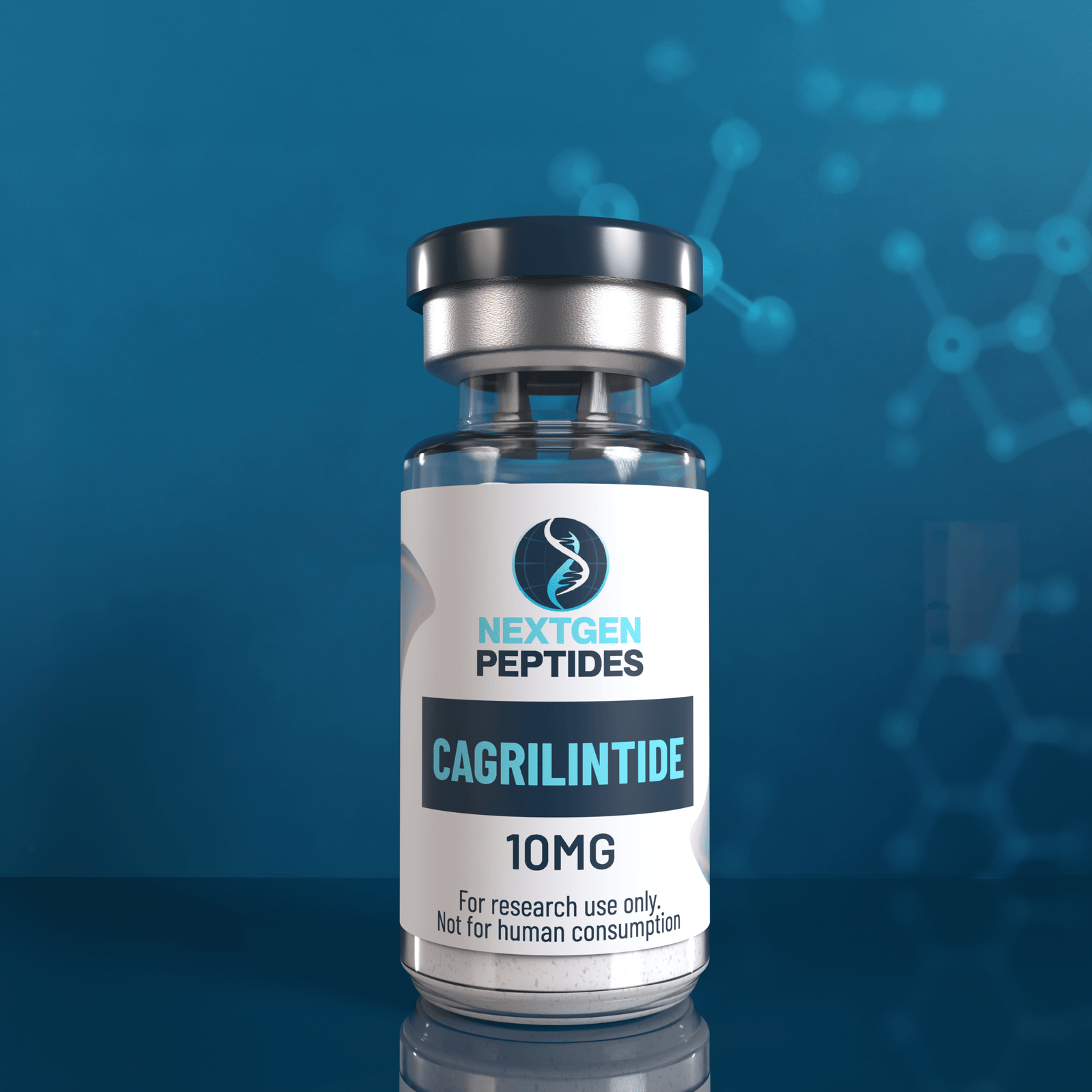

What Is Cagri (10 vials)?
Type Long-acting Amylin Receptor Agonist CAS Number 2134203-57-0 Molecular Weight 4408.258 g/mol Molecular Weight (Cu) N/A Amino Acids 37 Amino Acids (Modified Analog) Sequence Modified synthetic peptide analog of human amylin
Stability Information
High-purity synthetic peptideStructurally modified for enhanced stabilityProtected from light and moisture Lyophilized (powder) –20°C · up to 2 years Reconstituted 2-8°C · up to 30 days
About Cagri (10 vials)
Cagrilintide is a lyophilized synthetic peptide analog developed for scientific and laboratory research applications. It functions as a long-acting amylin receptor agonist, structurally modified to enhance stability and extend its biological activity profile in vivo. Cagrilintide has been studied for its synergistic effects when combined with GLP-1 receptor agonists, particularly in the context of appetite regulation, body weight management, and metabolic signaling. Its mechanism involves modulation of satiety-related pathways and delayed gastric emptying, making it a compound of interest in obesity and metabolic research.
Mechanism of Action
The mechanism involves Cagrilintide acting as a potent agonist for amylin receptors in the area postrema of the hindbrain. By activating these receptors, it triggers central satiety signals that reduce food intake. Furthermore, it slows gastric emptying, which contributes to a prolonged feeling of fullness. When used in research alongside GLP-1 agonists, it targets complementary pathways in the hypothalamus, investigating a multi-receptor approach to energy homeostasis and glucose metabolism.
What Research Has Shown
Metabolic Research 98 Purity Percentage (HPLC Verified) Synergistic Weight Management Signaling Cagrilintide + GLP-1 Analog 94.5% Single Receptor Agonist 62.0% Trial details: Preclinical studies in obesity and appetite signaling models focusing on delayed gastric emptying and metabolic regulation. Satiety Results
Appetite Regulation & Energy Homeostasis
Findings from amylin and GLP-1 receptor interaction studies
92% Satiety Signaling Enhanced Hypothalamic Activation 85% Gastric Emptying Significantly Delayed Rate Note: Results highlight the compound’s potential in obesity and metabolic research.
Research Highlights
Amylin Receptor Agonism
Research focusing on the long-acting structural modifications and their effect on receptor binding.
Synergistic Metabolic Signaling
Investigating the interaction between amylin and GLP-1 pathways for enhanced weight regulation.
Gastric Emptying Dynamics
Studies exploring the physiological delay in digestion and its impact on postprandial glucose.
Obesity & Appetite Models
Exploration of energy homeostasis and satiety-related pathways in preclinical laboratory models.
Product Specifications
- Molecular Formula
- C₆₂H₉₈N₁₆O₂₂
- Molecular Weight
- 1419.53 g/mol
- Sequence
- Gly-Glu-Pro-Pro-Pro-Gly-Lys-Pro-Ala-Asp-Asp-Ala-Gly-Leu-Val
- Purity
- ≥99% (HPLC verified)
- Form
- Lyophilized powder
- Appearance
- White to off-white powder
- Solubility
- Soluble in water, bacteriostatic water
- Storage
- -20°C (lyophilized), 2-8°C (reconstituted)
Research Studies
Cagrilintide: A Novel Long-Acting Amylin Analog
A comprehensive analysis of structurally modified amylin agonists in metabolic research.
Kruse T. & Hansen J.L. View Full Study
Frequently Asked Questions
What is the primary biological function of Cagrilintide?
It functions as a long-acting amylin receptor agonist, modulating satiety-related pathways and energy homeostasis.
Is it often studied alone or in combination?
While studied alone, it is a significant compound of interest for its synergistic effects when combined with GLP-1 receptor agonists in metabolic research.
Frequently bought together: GLOW (10Vials), NAD 500MG (10 vials), GLP-3 (10 Vials)
Related products