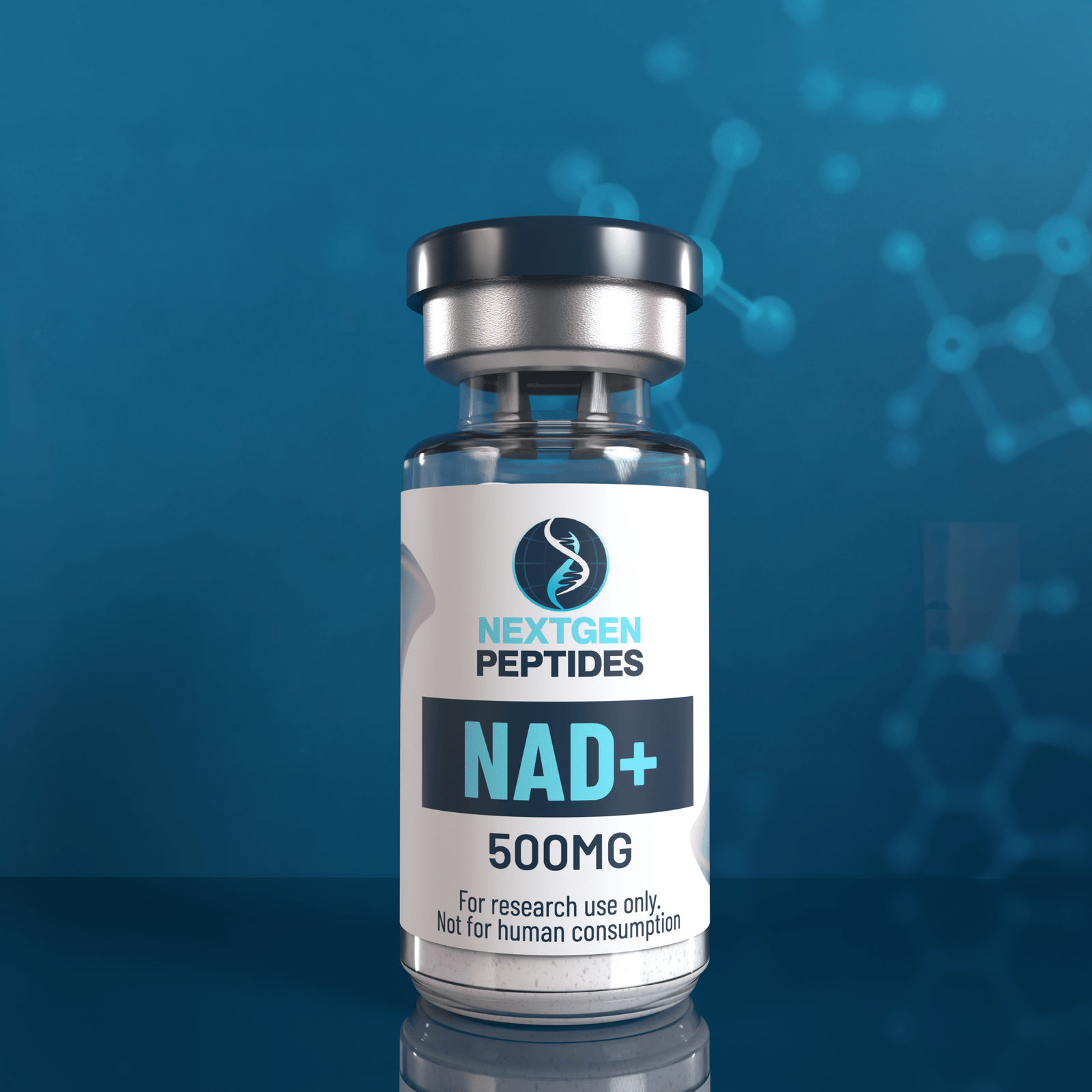

What Is NAD 500MG (10 vials)?
Type Coenzyme / Redox Cofactor CAS Number 53-84-9 Molecular Weight 663.4 g/mol Molecular Weight (Cu) N/A Amino Acids N/A (Nucleotide structure) Sequence N/A
Stability Information
High-purity lyophilized coenzymeHighly sensitive to light and moistureVital for mitochondrial function research Lyophilized (powder) –20°C · up to 2 years Reconstituted 2-8°C · up to 30 days
About NAD 500MG (10 vials)
Nicotinamide adenine dinucleotide (NAD⁺) is a high-purity lyophilized coenzyme form supplied exclusively for scientific and laboratory research. As a vital redox cofactor, NAD⁺ plays a central role in cellular metabolism, energy production, and mitochondrial function. NAD⁺ has been widely studied for its involvement in sirtuin activation, DNA repair, and cellular aging processes. Research indicates its significance in regulating oxidative stress responses, circadian rhythms, and metabolic signaling pathways, making it an essential tool in longevity and metabolic studies.
Mechanism of Action
The mechanism involves NAD⁺ acting as a primary electron carrier in the electron transport chain within mitochondria. By cycling between its oxidized (NAD⁺) and reduced (NADH) forms, it facilitates the production of ATP. Beyond energy, NAD⁺ serves as a necessary cofactor for enzymes like Sirtuins (which regulate gene expression and longevity) and PARPs (which detect and repair DNA damage). In research assays, maintaining high NAD⁺ levels is studied for its ability to preserve genomic stability and metabolic homeostasis.
What Research Has Shown
Metabolic Research 98 Purity Percentage (HPLC verified) Mitochondrial ATP Production NAD⁺ Supplemented 91.5% NAD⁺ Depleted Control 34.0% Trial details: Investigative studies focusing on the activation of sirtuins, DNA repair mechanisms, and the regulation of oxidative stress responses in laboratory models. Bioenergetic Results
Cellular Repair & Metabolic Signaling
Findings from mitochondrial biology and aging studies
94% DNA Repair Activity Enhanced PARP Signaling Note: Results highlight the essential role of NAD⁺ in maintaining cellular energy metabolism.
Research Highlights
Sirtuin & PARP Activation
Research focusing on the dependency of longevity-linked enzymes on NAD⁺ availability.
Mitochondrial Bioenergetics
Investigating the role of NAD⁺ in the Krebs cycle and mitochondrial respiratory efficiency.
Circadian Rhythm Regulation
Studies exploring how cellular NAD⁺ levels fluctuate to synchronize the body’s internal clock.
DNA Repair Mechanisms
Exploration of how NAD⁺-dependent signaling pathways mitigate oxidative DNA damage in model systems.
Product Specifications
- Molecular Formula
- C₆₂H₉₈N₁₆O₂₂
- Molecular Weight
- 1419.53 g/mol
- Sequence
- Gly-Glu-Pro-Pro-Pro-Gly-Lys-Pro-Ala-Asp-Asp-Ala-Gly-Leu-Val
- Purity
- ≥99% (HPLC verified)
- Form
- Lyophilized powder
- Appearance
- White to off-white powder
- Solubility
- Soluble in water, bacteriostatic water
- Storage
- -20°C (lyophilized), 2-8°C (reconstituted)
Research Studies
NAD⁺: The Central Catalyst of Cellular Metabolism
A comprehensive analysis of the coenzyme’s role in redox biology and mitochondrial signaling.
Imai S. & Guarente L. View Full Study
Frequently Asked Questions
What is the primary role of NAD⁺ in cellular biology?
It acts as a critical coenzyme in redox reactions, carrying electrons from one reaction to another to facilitate energy production.
Why is NAD⁺ significant in longevity research?
It is a required substrate for sirtuins and PARPs, enzymes that are essential for DNA repair and regulating cellular aging.
Frequently bought together: GLP-3 (10 Vials), TRZ (10 Vials), Selank
Related products