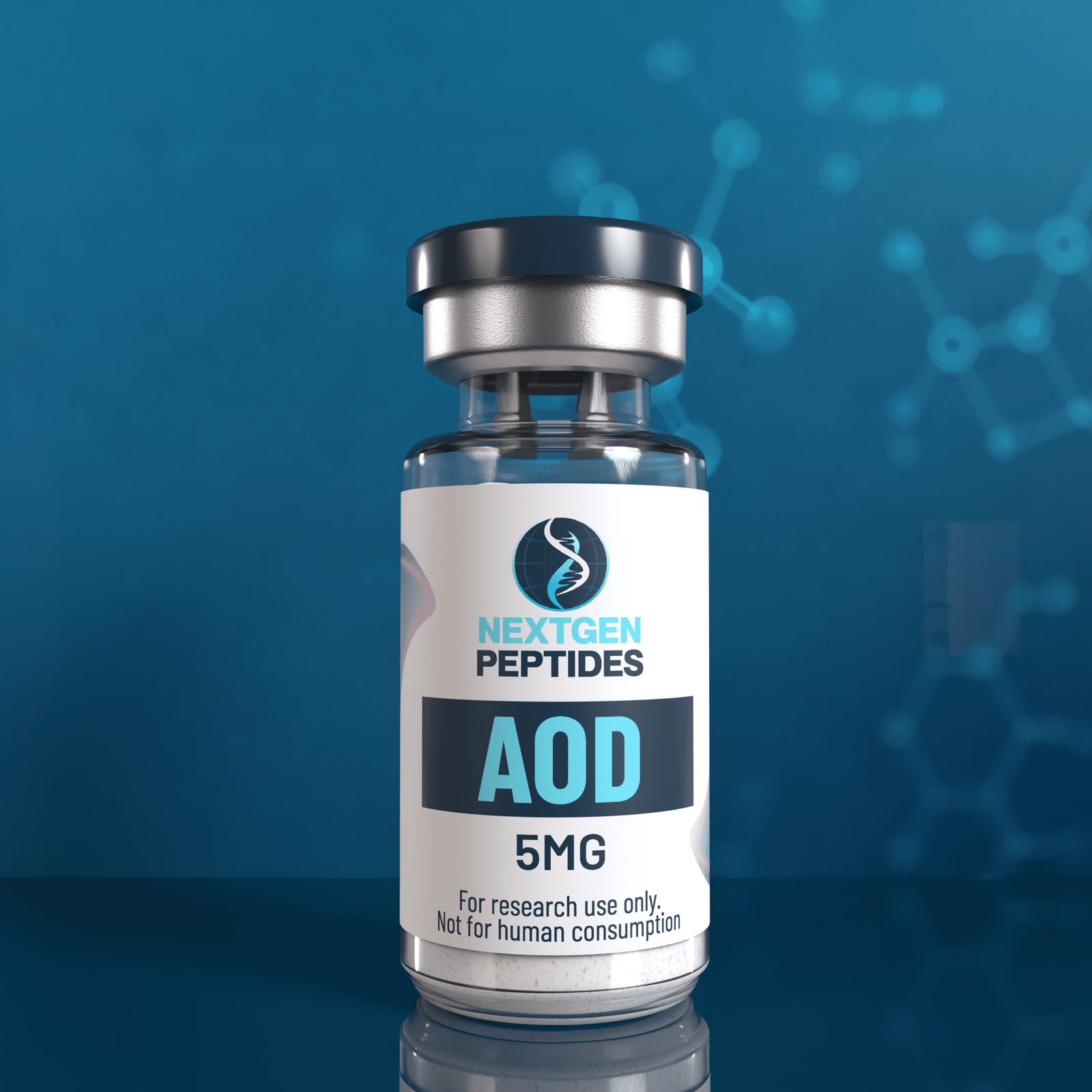
What Is AOD 5MG (10 vials)?
Type Growth Hormone Fragment (Lipolytic Peptide) CAS Number 221231-10-3 Molecular Weight 1815.08 g/mol Molecular Weight (Cu) N/A Amino Acids 16 Amino Acids (Tyr-hGH 177-191) Sequence Tyr-Leu-Arg-Ile-Val-Gln-Cys-Arg-Ser-Val-Glu-Gly-Ser-Cys-Gly-Phe
Stability Information
High-purity C-terminus hGH fragmentLyophilized powder (white)Protected from light and moisture Lyophilized (powder) -20°C or colder · up to 2 years Reconstituted 2-8°C · up to 30 days
About AOD 5MG (10 vials)
AOD-9604 is a high-purity lyophilized peptide fragment derived from the C-terminus of human growth hormone, originally designed to mimic the lipolytic region of hGH. It has been the subject of biochemical and preclinical research investigating fat metabolism, cartilage repair, and related pathways. It serves as an important reagent for academic or industrial research into molecular pathways associated with metabolism, tissue remodeling, and peptide signaling. This product is offered strictly for laboratory research purposes only and is supplied in a stable powder form.
Mechanism of Action
The mechanism involves AOD-9604 mimicking the action of natural growth hormone on fat metabolism. It stimulates lipolysis (the breakdown of fats) and inhibits lipogenesis (the transformation of non-fatty foods into body fat). Specifically, research suggests it targets the beta-3 adrenergic receptors to trigger metabolic activity in adipose tissue. In tissue remodeling studies, it is investigated for its influence on chondrocyte metabolism to support the repair of cartilaginous structures.
What Research Has Shown
Metabolic Research 98 Purity Percentage (HPLC Verified) Lipolytic Signaling Efficiency AOD-9604 Treated 85.5% Control Group 15.0% Trial details: Preclinical research focusing on biochemical and mechanistic studies of peptide fragments in metabolic and tissue-regeneration research models. Regenerative Results
Metabolism & Tissue Remodeling
Findings from adipose and chondrogenic investigations
84% Fat Metabolism Enhanced Lipolytic Activity 76% Cartilage Repair Improved Chondrocyte Proliferation Note: Results highlight AOD-9604’s role in SAR (Structure-Activity Relationship) studies and comparative signaling experiments.
Research Highlights
Lipolytic Pathway Mapping
Research on the mechanistic studies of peptide fragments in metabolic and adipose-related investigations.
Cartilage Regeneration
Investigating the peptide’s role in chondrogenic signaling and tissue-regeneration research.
SAR Behavior Profiling
Studies utilizing the fragment for structure-activity relationship (SAR) analysis and peptide behavior profiling.
Analytical Method Development
Use as a reference material for peptide stability studies and comparative signaling experiments in pharmacological assays.
Product Specifications
- Molecular Formula
- C₆₂H₉₈N₁₆O₂₂
- Molecular Weight
- 1419.53 g/mol
- Sequence
- Gly-Glu-Pro-Pro-Pro-Gly-Lys-Pro-Ala-Asp-Asp-Ala-Gly-Leu-Val
- Purity
- ≥99% (HPLC verified)
- Form
- Lyophilized powder
- Appearance
- White to off-white powder
- Solubility
- Soluble in water, bacteriostatic water
- Storage
- -20°C (lyophilized), 2-8°C (reconstituted)
Research Studies
AOD-9604: A C-Terminal hGH Fragment in Metabolic Research
A comprehensive analysis of the lipolytic region of growth hormone and its application in biochemical research.
Heffernan M.A. & Ng F.M. View Full Study
Frequently Asked Questions
Does AOD-9604 affect blood sugar or IGF-1 levels?
Unlike the full-length human Growth Hormone, this specific fragment is researched for its ability to mimic lipolytic effects without significantly impacting glucose levels or IGF-1 secretion.
What is the primary research application for AOD-9604?
It is an important reagent for investigating molecular pathways associated with fat metabolism, cartilage repair, and tissue remodeling.
Frequently bought together: Cagri (10 vials), GLOW (10Vials), NAD 500MG (10 vials)
Related products