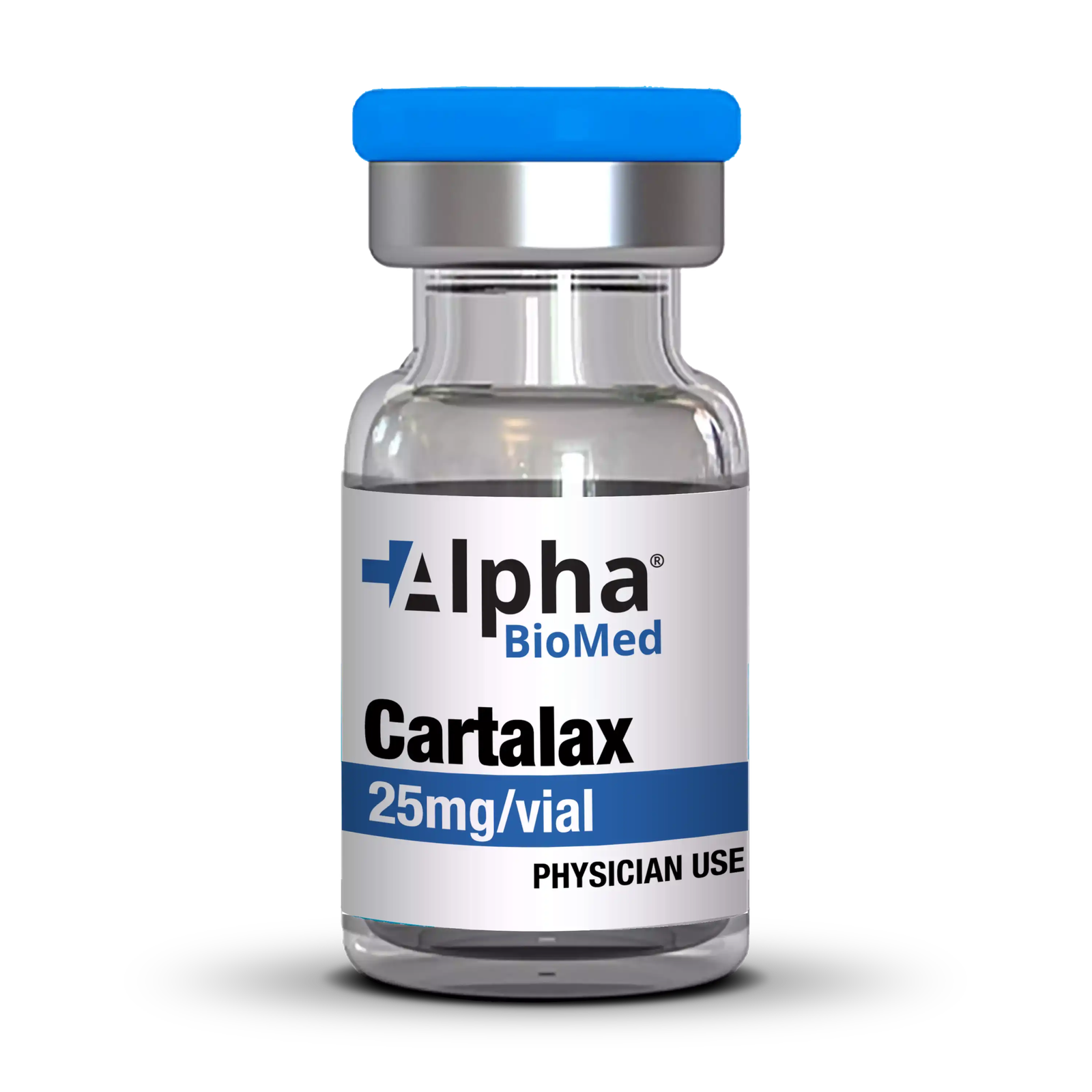

What Is Cartalax?
Type Cartilage Specific Peptide CAS Number 112163-33-4 Molecular Weight 390.4 g/mol Molecular Weight (Cu) N/A Amino Acids Ala-Glu-Asp Sequence L-Alanyl-L-glutamyl-L-aspartic acid Formula C_{12}H_{19}N_{3}O_{9} Storage Requirements
Stability Information
Protect from light and moistureKeep in a cool, dry environmentAvoid frequent temperature changes Lyophilized (powder) -20°C · up to 2 years Reconstituted 2-8°C · up to 30 days
About Cartalax
Cartalax is a synthetic peptide bioregulator consisting of three amino acids. It is specifically designed for research into the musculoskeletal system, where it acts as a molecular signal to help maintain and restore the functional integrity of cartilage, joints, and the spinal column in research models.
Mechanism of Action
The mechanism involves Cartalax interacting with the DNA of chondrocytes (cartilage cells). By binding to specific regulatory regions of DNA, it helps normalize the synthesis of essential proteins and collagen. This bioregulation helps restore the balance of metabolic processes within the connective tissues, especially those affected by age-related or mechanical stress.
What Research Has Shown
Osteo-Articular Research 79 Chondrocyte Activity Index Connective Tissue Recovery artalax Research Group 75.8% Trial details: nvestigative studies focusing on the regeneration of cartilaginous tissue and the functional restoration of the spine in aging laboratory models. Connective Tissue Results
oint and Spine Homeostasis
Findings from cellular metabolism investigations
75% Collagen Synthesis Enhanced Chondrocyte Activity 68% Tissue Metabolism Normalized Joint Homeostasis Note: Results highlight the peptide’s ability to regulate tissue-specific gene expression.
Research Highlights
Chondrocyte Metabolism
Research focusing on how Cartalax stimulates the production of cartilage-specific proteins.
Spine Integrity Studies
Investigating the peptide’s role in maintaining the health of intervertebral discs in animal models.
Collagen Synthesis Support
Studies exploring the enhancement of the extracellular matrix within joint tissues.
Tissue-Specific Gene Expression
Exploration of how short peptides regulate the biological activity of connective tissue at the genetic level.
Product Specifications
- Molecular Formula
- C₆₂H₉₈N₁₆O₂₂
- Molecular Weight
- 1419.53 g/mol
- Sequence
- Gly-Glu-Pro-Pro-Pro-Gly-Lys-Pro-Ala-Asp-Asp-Ala-Gly-Leu-Val
- Purity
- ≥99% (HPLC verified)
- Form
- Lyophilized powder
- Appearance
- White to off-white powder
- Solubility
- Soluble in water, bacteriostatic water
- Storage
- -20°C (lyophilized), 2-8°C (reconstituted)
Research Studies
Bioregulation of Connective Tissue
A study on the effects of the Ala-Glu-Asp peptide chain on cartilage and joint health.
Khavinson V.Kh. & Lezhava T.A. View Full Study Peptides in Osteo-Articular Regeneration
Analysis of short-chain peptides and their influence on chondrocyte regeneration in laboratory models.
ournal of Aging & Clinical Research (2024) View Full Study
Frequently Asked Questions
What is the primary focus of Cartalax research?
Research focuses on its role in normalizing metabolism in cartilage cells and supporting the health of the spine and joints in animal models.
Is Cartalax a growth hormone?
No, it is a short-chain peptide bioregulator that acts as a biological signal to support tissue-specific protein synthesis.
Frequently bought together: AHK-Cu, BPC Caps, Thymosin Alpha 1
Related products